

Area and perimeter of a trapezoid
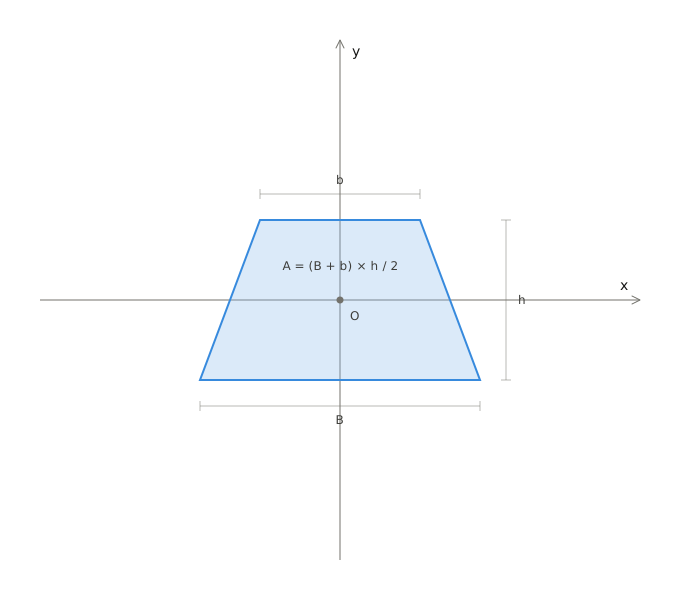
The area of a trapezoid with bases B and b and height h is A = (B + b) · h / 2; the perimeter is P = B + b + c + d, where c and d are the oblique sides. Enter the bases, the height and the oblique sides and choose the unit of measure: the calculator shows area and perimeter. Example: with B = 80 mm, b = 50 mm and h = 40 mm the area is 2600 mm²; with oblique sides of 40 and 50 mm the perimeter is 220 mm.
Calculator
| Units | |
| Major base B | |
| Minor base b | |
| Height h | |
| Oblique side c | |
| Oblique side d |
| Area (A = (B+b)·h/2) | 0 mm² |
| Perimeter | 0 mm |
Definition
A trapezoid (or trapezium) is a quadrilateral with at least one pair of parallel opposite sides, called bases: the major base (B, longer) and the minor base (b, shorter). The other two sides, in general not parallel, are called oblique sides (c and d).
The height (h) is the perpendicular distance between the two parallel bases. A parallelogram, and therefore also a rectangle, is a trapezoid with B = b (equal bases); the triangle is obtained as the limiting case with b = 0, when the minor base shrinks to a point.
Area formula
The area of a trapezoid is calculated as the average of the two bases multiplied by the height:
The formula can be proven in several ways. One of the most intuitive: taking two identical copies of the trapezoid and rotating one by 180°, the two shapes fit together forming a parallelogram with base (B + b) and height h:
The formula generalizes both the rectangle (with B = b it becomes A = B · h) and the triangle (with b = 0 it becomes A = B · h / 2).
Perimeter formula
The perimeter is the sum of the four sides:
Unlike the area, the perimeter requires knowing the two oblique sides (c and d) as well: knowing only bases and height, infinitely many different trapezoids have the same area but different perimeters, the same phenomenon seen for the triangle with only base and height.
The oblique sides are not free, however: if the minor base is shifted by a distance p relative to the end of the major base (p can also be negative), the following hold:
This is why the tool shows a warning when the oblique sides entered are not compatible with the bases and the height: in that case the perimeter is only the sum of the four values entered.
Isosceles and right trapezoid
There are two notable special cases:
Isosceles trapezoid: the two oblique sides are equal (c = d). The trapezoid is symmetric about the line perpendicular to the bases through their midpoints, and the base angles are equal in pairs. In this case p = (B − b) / 2 and:
Right trapezoid: one of the oblique sides is perpendicular to the bases and therefore coincides with the height. If c is the perpendicular side, c = h holds and the remaining oblique side d comes from the Pythagorean theorem, applied to the right triangle formed by the difference of the bases and the height:
Practical example
Given: B = 80 mm, b = 50 mm, h = 40 mm
Area: A = (80 + 50) / 2 × 40 = 65 × 40 = 2600 mm²
Right trapezoid: c = h = 40 mm, d = √(40² + 30²) = 50 mm
Perimeter: P = 80 + 50 + 40 + 50 = 220 mm
Isosceles trapezoid: c = d = √(40² + 15²) = √1825 ≈ 42.72 mm
Perimeter: P = 80 + 50 + 2 × 42.72 ≈ 215.44 mm
The area is the same in both cases: it depends only on B, b and h. The oblique sides c and d change the shape of the trapezoid (how slanted the sides are) and the perimeter, but not the area, which remains determined by the distance between the parallel bases and their average length.
Applications
The trapezoid is a geometric shape with many practical applications:
Civil and hydraulic engineering: trapezoidal cross-sections are very common in drainage channels, embankments and earth dams, because they offer good stability with efficient use of material.
Architecture: trapezoidal roofs, windows and decorative elements, as well as calculating the area of non-rectangular plots of land that can be approximated as trapezoids.
Numerical analysis: the trapezoidal rule is one of the simplest and most widely used methods for approximating a definite integral, by dividing the area under a curve into a series of small trapezoids.
Surveying: calculating the area of irregular plots of land is often based on decomposing them into trapezoids from base measurements and partial heights.