

Area and perimeter of an ellipse
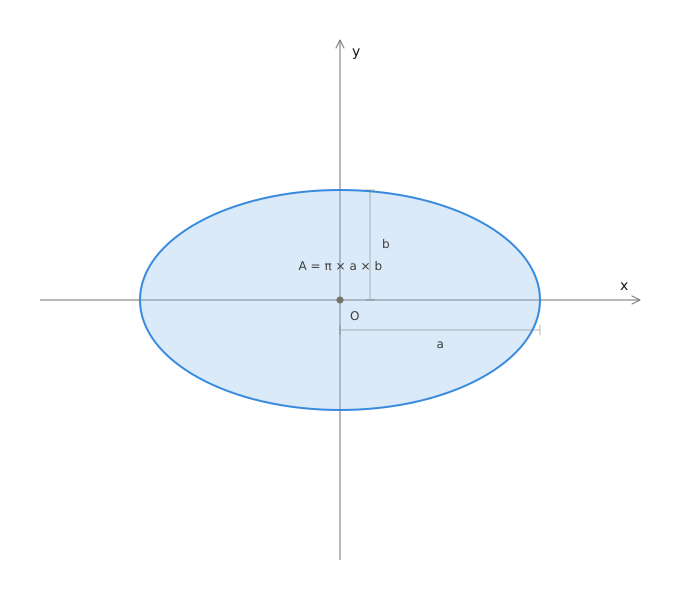
The area of an ellipse with semi-axes a and b is A = π · a · b. The perimeter has no exact elementary formula: the tool uses Ramanujan’s approximation. Enter the major and minor axes and choose the unit of measure: the calculator shows area, perimeter and semi-axes. Example: with axes of 100 mm and 60 mm (a = 50 mm, b = 30 mm), A ≈ 4,712.39 mm² and P ≈ 255.27 mm.
Calculator
| Units | |
| Major axis | |
| Minor axis |
| Area (A = π·a·b) | 0 mm² |
| Perimeter (Ramanujan) | 0 mm |
| Semi-major axis (a) | 0 mm |
| Semi-minor axis (b) | 0 mm |
Definition
An ellipse is the geometric locus of points in a plane for which the sum of the distances from two fixed points, called foci, is constant. It is a generalization of the circle: while a circle has a single center equidistant from all points, an ellipse has two foci and the resulting shape is “stretched”.
An ellipse is characterized by two perpendicular axes: the major axis (the longer diameter) and the minor axis (the shorter diameter). Their halves are the semi-major axis (a) and the semi-minor axis (b):
When a = b the ellipse becomes a circle: a circle is therefore a special case of an ellipse, with the two foci coinciding at the center.
Area formula
The area of an ellipse has a simple, exact formula:
It is the natural generalization of the circle’s area (A = πr²): a circle is an ellipse with a = b = r and, substituting, we get exactly πr² = πr · r.
An intuitive proof: an ellipse can be obtained from a circle of radius a by “squashing” it vertically by a factor of b/a. This transformation (a linear change of scale) multiplies all areas by the same factor b/a:
The perimeter problem
Unlike the area, the perimeter of an ellipse has no exact elementary formula. Mathematically it is expressed by an elliptic integral of the second kind, which cannot be written using only elementary operations (addition, roots, trigonometric functions):
This integral has no elementary closed-form solution. Historically, the study of these integrals, which arose precisely from the problem of the length of the ellipse, gave rise to the elliptic functions of Jacobi and Weierstrass.
For practical use, very precise numerical approximations are therefore used.
Ramanujan’s approximation
This tool uses the approximation proposed by the Indian mathematician Srinivasa Ramanujan (1887-1920), one of the most accurate known:
The relative error is very small: at most about 0.04%, reached in the limiting case of an ellipse flattened into a segment, and zero for the circle. It is more than sufficient for any practical engineering or design application.
Checking the limiting case: when a = b we have h = 0, so the formula reduces to P = π(a + a)(1 + 0) = 2πa, exactly the circumference of a circle of radius a.
Practical example
Given: major axis = 100 mm, minor axis = 60 mm
Semi-axes: a = 50 mm, b = 30 mm
Area: A = π × 50 × 30 ≈ 4,712.39 mm²
Parameter h: h = (50 − 30)² / (50 + 30)² = 400 / 6400 = 0.0625
Perimeter: P ≈ π × 80 × [1 + (3 × 0.0625) / (10 + √(4 − 3 × 0.0625))] ≈ 255.27 mm
For comparison, a circle whose radius equals the semi-major axis (r = 50 mm) has a perimeter of 2π × 50 ≈ 314.16 mm: the ellipse, being more “squashed”, has a smaller perimeter for the same semi-major axis.
Applications
The ellipse is one of the most important curves in science and engineering:
Astronomy: according to Kepler’s first law, planetary orbits around the Sun are ellipses, with the Sun at one of the two foci and not at the center.
Optics and acoustics: an elliptical reflective surface focuses waves (light, sound) emitted from one focus exactly onto the other focus: this is the principle of elliptical rooms in which a whisper at one focus can be heard at the other, and of some devices that concentrate shock waves, such as lithotripters.
Mechanical engineering: elliptical cross-sections are used in pipes, ducts and structural components, where a compromise between strength and aerodynamics is needed compared with a circular cross-section.
Design and architecture: elliptical pools, tables, windows and domes, where the area formula is used to calculate the materials needed.