

Area, perimeter and diameter of a circle
The area of a circle is A = π · r², where r is the radius; the perimeter (the circumference) is P = 2π · r and the diameter is D = 2r. Enter the radius or the diameter and choose the unit of measure: the calculator shows area, perimeter and diameter. Example: with r = 100 mm, A ≈ 31,415.93 mm², P ≈ 628.32 mm and D = 200 mm.
Calculator
| Units | |
| Available value | |
| Value |
| Area (A = π · r²) | 0 mm² |
| Perimeter (P = 2πr) | 0 mm |
| Diameter (D = 2r) | 0 mm |
Definition
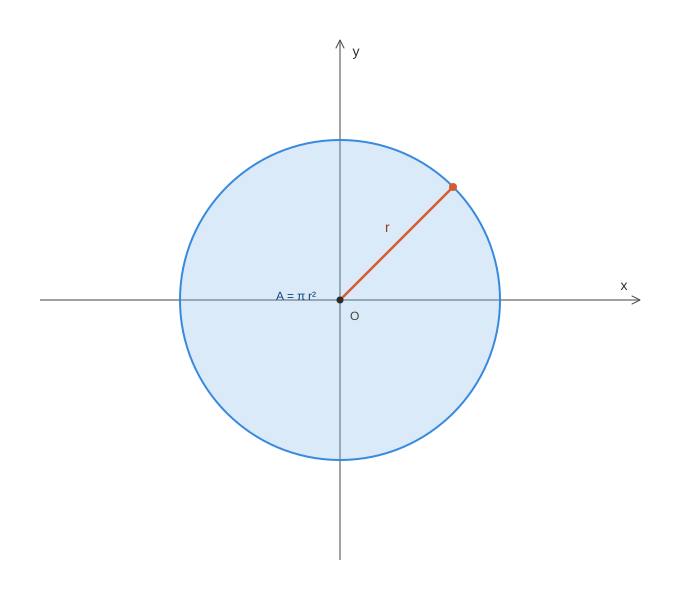
A circle is the geometric locus of points in a plane that are equidistant from a fixed point, called the center. The constant distance between the center and any point on the circle is the radius (r). The diameter (D) is the segment passing through the center connecting two opposite points on the circle, and equals twice the radius:
The perimeter (or circumference) is the length of the circle’s boundary, while the area is the measure of the surface enclosed within it.
Fundamental formulas
The three main quantities of a circle are calculated using these formulas:
where:
All formulas depend on a single independent quantity (the radius, or equivalently the diameter): knowing any one of the four quantities allows all the others to be derived.
Where π comes from
The constant π (pi) is defined as the ratio between the circumference of any circle and its diameter:
This ratio is constant for every circle, regardless of size: a tiny circle and a huge circle have exactly the same P/D ratio. The property was already observed empirically by ancient civilizations (Babylonians and Egyptians), who used approximations such as 25/8 or (16/9)², but it was Archimedes of Syracuse (3rd century BC) who first calculated a rigorous approximation, inscribing and circumscribing regular polygons around the circle with an increasing number of sides.
π is an irrational number (it cannot be expressed as a fraction of two integers, proven by Lambert in 1761) and transcendental (it is not the root of any polynomial with rational coefficients, proven by Lindemann in 1882). Its decimal expansion is therefore infinite and non-repeating:
For practical engineering calculations, π ≈ 3.14159 is almost always sufficient; the calculator uses the value of π from the browser’s math library (Math.PI, double precision).
Derivation of the area formula
The formula A = πr² is not arbitrary: it can be derived intuitively by imagining the circle divided into many very thin circular sectors, like slices of a pie, and arranging them alternately (one pointing up, one pointing down) to form a shape that increasingly resembles a rectangle as the sectors become thinner.
This “approximated rectangle” has the radius (r) as its height and half the circumference as its base (because the circumference is split evenly between the top and bottom sides):
The area of the rectangle (and thus, in the limit, of the circle) is the product of base and height:
The same reasoning, formalized with integral calculus (integrating the area element over the entire circle in polar coordinates), confirms exactly the formula:
Relationships between the quantities
Knowing just one quantity of the circle allows all the others to be derived. Here are the most useful relationships:
From the radius:
From the diameter:
From the perimeter (circumference):
From the area:
This tool lets you start from either the radius or the diameter: the other values are calculated accordingly.
Practical example
Given: radius r = 100 mm
Diameter: D = 2 × 100 = 200 mm
Perimeter: P = 2π × 100 ≈ 628.32 mm
Area: A = π × 100² ≈ 31,415.93 mm²
The same circle measured in centimeters (r = 10 cm) gives D = 20 cm, P ≈ 62.83 cm and A ≈ 314.16 cm². The point to remember: area scales with the square of the unit conversion factor (10² = 100), while perimeter and diameter scale linearly (× 10).
Applications
Calculating the area and perimeter of a circle underlies many practical applications:
Mechanical engineering: pipe sizing, fluid flow rate calculations in circular ducts, gear and pulley design.
Construction and architecture: calculating the surface area of columns, domes and circular windows, and the amount of material needed for circular flooring or roofing.
Electronics: wire and conductor cross-sections, where the area of the circular cross-section affects electrical resistance and maximum allowable current.
Everyday life: calculating the amount of paint or material needed for a circular surface, sizing lids, wheels and circular objects in general.
The circle is also the starting point for studying more complex shapes such as the ellipse, circular sector, circular segment and annulus, all built from the same fundamental formulas.