

Area and perimeter of a regular hexagon
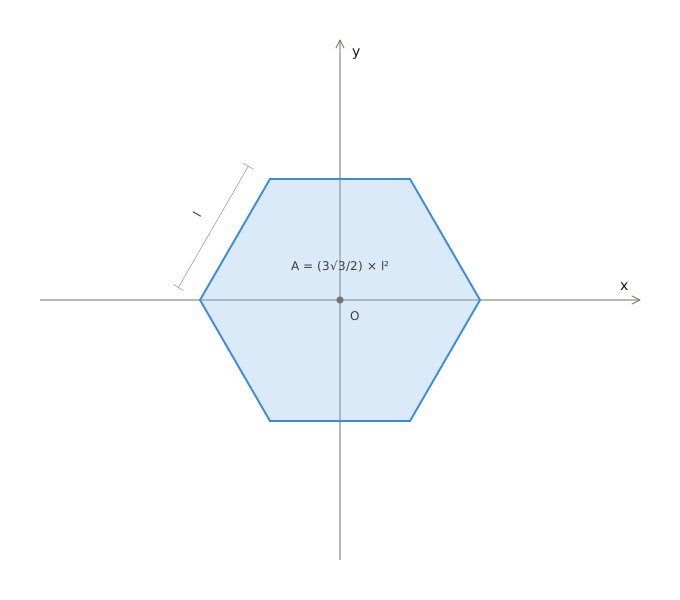
The area of a regular hexagon with side L is A = (3√3 / 2) · L² ≈ 2.598 · L²; the perimeter is P = 6L. Enter the side length and choose the unit of measure: the calculator shows perimeter, apothem, area and circumscribed radius. Example: with L = 100 mm, P = 600 mm, apothem ≈ 86.60 mm, A ≈ 25,980.76 mm² and R = 100 mm.
Calculator
| Units | |
| Side |
| Perimeter (P = 6·L) | 0 mm |
| Apothem | 0 mm |
| Area | 0 mm² |
| Circumscribed radius | 0 mm |
Definition
A regular hexagon is a polygon with six sides of equal length and six equal interior angles, each measuring 120°. It is fully determined by a single parameter: the side length (L).
A remarkable property of the regular hexagon is that it decomposes exactly into 6 congruent equilateral triangles, each with side L, all sharing a vertex at the center of the figure. This decomposition is the key to deriving all the hexagon’s formulas.
The regular hexagon is also one of only three regular polygons (together with the equilateral triangle and the square) that can tile the plane on their own, without leaving gaps. Among the ways of dividing the plane into cells of equal area, the hexagonal one has the smallest total perimeter (the honeycomb conjecture, proved by Thomas Hales in 1999): this is the reason behind the structure of honeycombs.
Apothem and circumscribed radius
The apothem is the distance from the hexagon’s center to the midpoint of a side, that is, the height of one of the 6 equilateral triangles. Since an equilateral triangle of side L has height:
and this height coincides with the hexagon’s apothem:
The circumscribed radius (distance from the center to a vertex) is, on the other hand, equal to the side:
Every equilateral triangle composing the hexagon has all three sides equal to L: the radius, which is one of the triangle’s sides starting from the center, is therefore equal to the hexagon’s side.
Perimeter and area formula
With 6 equal sides, the perimeter is immediate:
The area comes from the decomposition into 6 equilateral triangles. The area of a single triangle is half the product of base (the side L) and height (the apothem):
Multiplying by the 6 triangles that make up the hexagon:
An equivalent form, valid for any regular polygon, is the product of the semi-perimeter and the apothem:
which is the formula used by this tool.
Practical example
Given: side L = 100 mm
Perimeter: P = 6 × 100 = 600 mm
Apothem: a = (√3 / 2) × 100 ≈ 86.60 mm
Area: A = (600 × 86.60) / 2 ≈ 25,980.76 mm²
Circumscribed radius: R = 100 mm (equal to the side)
Applications
The regular hexagon is one of the most widespread geometric shapes in nature and engineering, thanks to its efficiency in tiling the plane:
Biology: beehives have hexagonal cells: this shape requires the least wax (perimeter) to enclose a given volume of honey compared with any other division of the plane into equal cells.
Engineering and materials: honeycomb structures are used in sandwich panels for aerospace and for packaging, and offer good structural strength at low weight.
Chemistry and crystallography: graphene is a hexagonal lattice of carbon atoms and graphite consists of stacked layers of graphene; many minerals crystallize with hexagonal symmetry.
Urban planning and games: hexagonal grids are used in strategy game maps and in some paving patterns, because each cell has exactly 6 adjacent cells at equal distance, unlike a square grid.