

Area and perimeter of a rectangle
The area of a rectangle is found by multiplying its two sides, A = a · b, and the perimeter with P = 2 · (a + b). Enter sides A and B and choose the unit of measure: the calculator shows the area and the perimeter. Example: with a = 8 m and b = 5 m, A = 40 m² and P = 26 m.
Calculator
| Units | |
| Side A | |
| Side B |
| Area | 0 mm² |
| Perimeter | 0 mm |
Definition
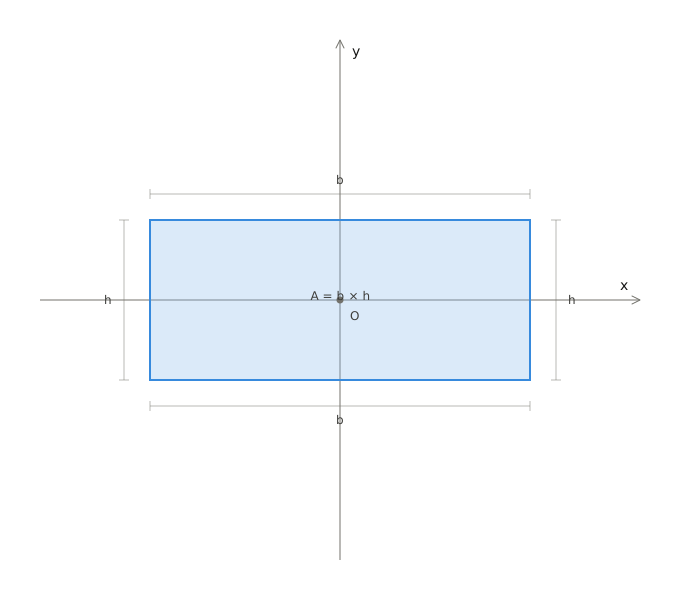
A rectangle is a flat quadrilateral with four right angles (90°), where opposite sides are parallel and of equal length. Denoting by a and b the lengths of two consecutive sides (called base and height, or side A and side B), the rectangle is fully determined by these two values.
The rectangle is a special case of a parallelogram (it has parallel opposite sides). In turn, the square is a special case of a rectangle: when a = b, the rectangle becomes a square.
Fundamental formulas
The two main quantities of a rectangle are calculated using these formulas:
where:
Area is measured in square units (for example m², cm²), while perimeter is measured in linear units (for example m, cm), the same unit used for the sides.
Why the area is the product of the sides
The formula A = a × b comes directly from the definition of area as “the number of unit squares covering the surface”. If the rectangle has base a and height b and is divided into a grid of unit squares, it forms exactly a columns and b rows of squares:
This is also why area is measured in “square” units: each unit square represents one unit of surface, and their total count is the product of the two dimensions. This principle underlies integral calculus for more complex areas: the area under a curve is obtained by summing infinitely many infinitesimal rectangles (the foundation of the definite integral).
Why the perimeter is 2(a + b)
The perimeter is the sum of the lengths of all sides. A rectangle has four sides, but they are equal in pairs (two sides of length a and two sides of length b):
This formula holds for any parallelogram with equal, parallel opposite sides, not just for rectangles.
Relationship between area and perimeter
Unlike the circle (where both area and perimeter are determined by the radius alone), in a rectangle area and perimeter are not tied by a fixed relationship: rectangles with the same perimeter can have very different areas, and vice versa.
A notable result in geometry: for a fixed perimeter P, the rectangle with maximum area is the square (a = b = P/4):
It can be proven with the inequality between the arithmetic and geometric means: for a fixed sum a + b, the product a × b is largest when a = b. This is why, for the same amount of fencing material, a square plot of land encloses more area than an elongated rectangle.
Practical example
Given: side A = 8 m, side B = 5 m
Area: A = 8 × 5 = 40 m²
Perimeter: P = 2 × (8 + 5) = 2 × 13 = 26 m
If the unit of measure changes, for example converting the sides to centimeters (800 cm × 500 cm), the area becomes 400,000 cm² while the perimeter becomes 2,600 cm: converting area requires the square of the linear conversion factor (100² = 10,000), while perimeter scales linearly (× 100).
Applications
Calculating the area and perimeter of a rectangle is among the most widely used geometric calculations, with applications ranging from:
Construction: calculating room surfaces, flooring, wall plastering, and the amount of tiles or parquet needed.
Agriculture and land: calculating cultivable surfaces, sizing fences (perimeter) for a given area.
Fabrics and materials: calculating the square meters of fabric, paper or sheet metal needed for a project.
Computing and graphics: the rectangle is the basis of every screen coordinate system (pixels, bounding boxes, responsive layouts).
The rectangle is also the starting point for studying the general parallelogram (where angles are not necessarily right angles) and for calculating composite areas, by decomposing irregular shapes into simpler rectangles.