

Area, side and perimeter of a rhombus
The area of a rhombus with diagonals D and d is A = D · d / 2; the side is L = √((D/2)² + (d/2)²), the perimeter is P = 4L and the height is h = A / L. Enter the two diagonals and choose the unit of measure: the calculator shows area, side, perimeter and height. Example: with D = 100 mm and d = 60 mm, A = 3000 mm², L ≈ 58.31 mm, P ≈ 233.24 mm and h ≈ 51.45 mm.
Calculator
| Units | |
| Major diagonal D | |
| Minor diagonal d |
| Area (A = D·d/2) | 0 mm² |
| Side | 0 mm |
| Perimeter (P = 4·L) | 0 mm |
| Height | 0 mm |
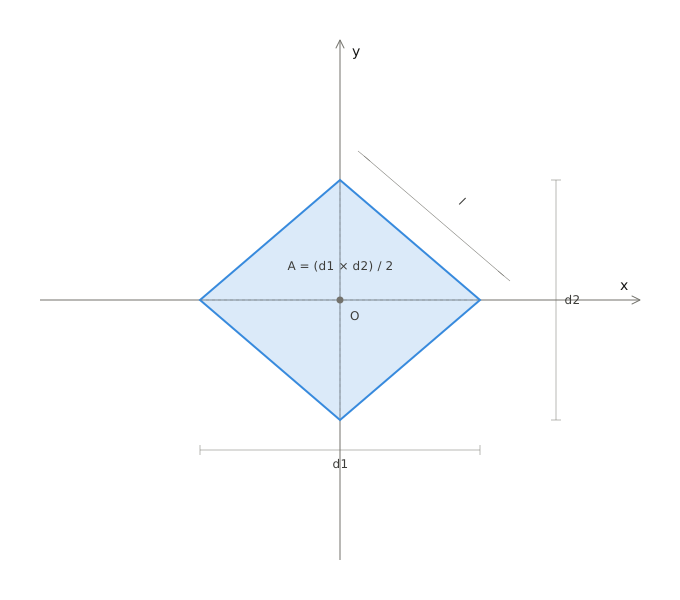
Definition
A rhombus is a quadrilateral with all four sides of equal length. It is a special case of a parallelogram: opposite sides are parallel and opposite angles are equal.
It differs from a square because its interior angles are not necessarily right angles: it can be seen as a “deformed” square, in which the two diagonals determine shape and area.
The two diagonals have three key properties: they are perpendicular to each other, they bisect each other at the point of intersection, and they bisect the angles of the rhombus.
Area formula
Because the diagonals are perpendicular, the area is calculated as:
where D is the major diagonal and d is the minor diagonal. The formula comes from splitting the rhombus into 4 congruent right triangles with legs D/2 and d/2:
As for every parallelogram, the area is also the product of the side and the corresponding height: A = L · h.
Calculating the side
Since the diagonals intersect perpendicularly at their midpoint, each side is the hypotenuse of a right triangle with legs D/2 and d/2. By the Pythagorean theorem:
Perimeter and height
The perimeter, since all sides are equal, is simply:
The height (the perpendicular distance between two opposite sides) comes from the general parallelogram formula, dividing the area by the side:
Practical example
Given: D = 100 mm, d = 60 mm
Area: A = (100 × 60) / 2 = 3000 mm²
Side: L = √(50² + 30²) = √3400 ≈ 58.31 mm
Perimeter: P = 4 × 58.31 ≈ 233.24 mm
Height: h = 3000 / 58.31 ≈ 51.45 mm
Applications
Calculating the area of a rhombus is useful in architecture (diamond-pattern flooring, decorative glass panels), in mechanical design (rhombic cross-sections of structural components) and in crystallography (unit cell of certain crystal lattices).
Note: every square is a rhombus with equal diagonals; every rhombus with a 90° interior angle is a square.