

Area and perimeter of a regular pentagon
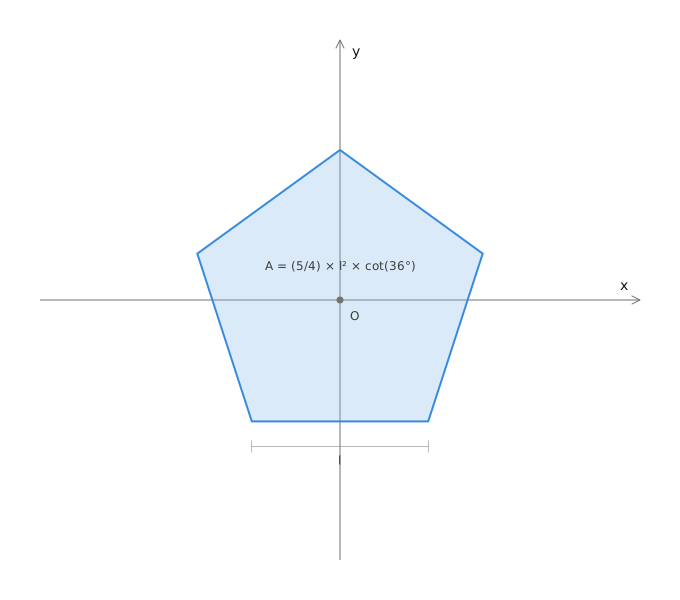
The area of a regular pentagon with side L is A = 5L² / (4 · tan 36°) ≈ 1.7205 · L²; the perimeter is P = 5L. Enter the side length and choose the unit of measure: the calculator shows perimeter, apothem, area and circumscribed radius. Example: with L = 100 mm, P = 500 mm, apothem ≈ 68.82 mm, A ≈ 17,204.77 mm² and R ≈ 85.07 mm.
Calculator
| Units | |
| Side |
| Perimeter (P = 5·L) | 0 mm |
| Apothem | 0 mm |
| Area | 0 mm² |
| Circumscribed radius | 0 mm |
Definition
A regular pentagon is a polygon with five sides of equal length and five equal interior angles, each measuring 108°. It is fully determined by a single parameter: the side length (L).
Like every regular polygon, the pentagon can be decomposed into 5 congruent isosceles triangles, all sharing a vertex at the center of the figure and a base equal to side L. This decomposition is the key to deriving all the pentagon’s formulas and is a general method, applicable to any regular polygon with n sides.
The regular pentagon is historically linked to the golden ratio (φ ≈ 1.618): the ratio between a diagonal and the side is exactly the golden number, a property that makes it prominent in art, architecture and geometric symbolism. The pentagram, the five-pointed star, is obtained precisely by drawing the diagonals of a regular pentagon.
Apothem and circumscribed radius
For a regular polygon with n sides, the apothem (distance from the center to the midpoint of a side) and the circumscribed radius (distance from the center to a vertex) come from the trigonometry of the right triangle obtained by halving one of the isosceles triangles of the decomposition: it has an angle π/n at the center, a leg L/2 on the side, and the apothem as the other leg.
For the pentagon n = 5: the central angle of each triangle is 360°/5 = 72° and its half (36° = π/5 radians) is the one used in the formulas:
Perimeter and area formula
With 5 equal sides, the perimeter is immediate:
The area, as for any regular polygon, is the product of the semi-perimeter and the apothem (the sum of the areas of the 5 isosceles triangles that make up the figure):
Substituting the trigonometric expressions gives the direct formula in terms of the side alone:
The general formula (semi-perimeter times apothem) is useful because it applies, by simply substituting n, to any regular polygon: equilateral triangle, square, pentagon, hexagon and so on.
Practical example
Given: side L = 100 mm
Perimeter: P = 5 × 100 = 500 mm
Apothem: a = 100 / (2 · tan 36°) ≈ 68.82 mm
Area: A = (500 × 68.82) / 2 ≈ 17,204.77 mm²
Circumscribed radius: R = 100 / (2 · sin 36°) ≈ 85.07 mm
Applications
The regular pentagon is less common than the hexagon in tiling the plane: on its own it cannot cover it without leaving gaps, because the 108° interior angle is not a divisor of 360°. It still appears in many applications:
Architecture and symbolism: the Pentagon, headquarters of the U.S. Department of Defense near Washington, pentagon-shaped buildings and historical geometric symbols based on the golden ratio.
Biology and crystallography: many viruses have a capsid with icosahedral symmetry, in which the 12 vertices are occupied by groups of five protein subunits; some flowers and marine organisms, such as starfish, also show pentagonal symmetry.
Design and solids: decorative elements, logos and the dodecahedron, one of the 5 Platonic solids, which has all 12 faces pentagonal.
Sports: the classic soccer ball alternates 12 pentagons and 20 hexagons on a surface approximating a sphere (a truncated icosahedron).