

Area and perimeter of a triangle
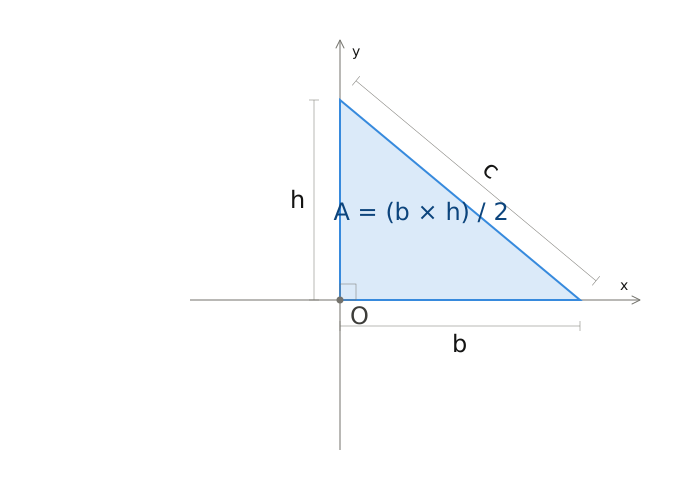
The area of a triangle is A = b · h / 2 if you know the base and the height, or it can be found with Heron’s formula if you know the three sides. Choose the available data, enter the values and the unit of measure: the calculator shows the area and, with the three sides, the perimeter too. Example: base 40 mm and height 30 mm give A = 600 mm²; the triangle with sides 30, 40 and 50 mm has the same area.
Calculator
| Units | |
| Available data |
| Base | |
| Height |
| Area | 0 mm² |
| Perimeter | N/A mm |
Perimeter cannot be calculated from base and height alone: infinitely many different triangles share the same base and height.
Definition
A triangle is a polygon with three sides and three interior angles, whose sum is always 180°. It is the simplest geometric shape (the minimum number of sides that encloses a surface), and every more complex polygon can be decomposed into triangles: a principle underlying triangulation, used in computer graphics, cartography and structural engineering.
A triangle is determined by three suitable pieces of data among sides and angles (for example three sides, or two sides and the included angle). This tool calculates area and perimeter starting from two data sets: base and height, or the three sides.
Mode 1: base and height
If the base (b) and the corresponding height (h, the perpendicular distance from the opposite vertex to the base) are known, the area is calculated with the simplest formula in geometry:
This formula comes from the fact that every triangle is exactly half of a parallelogram with the same base and height: taking a triangle and a copy of it rotated by 180°, the two shapes fit together perfectly, forming a parallelogram of area b × h.
Important: knowing only base and height, the perimeter cannot be determined. With the base fixed, the opposite vertex can be in infinitely many different positions while keeping the same perpendicular distance from the base (the same height): each of these positions produces a triangle with the same area but different oblique sides, and therefore a different perimeter. Calculating the perimeter requires additional information, such as where the foot of the height falls on the base, or the lengths of the two oblique sides.
Mode 2: three sides (Heron’s formula)
If the three sides (a, b, c) are known, the area is calculated with Heron’s formula, which requires no angle or height to be known:
where s is the semi-perimeter:
This formula, attributed to the Greek mathematician Heron of Alexandria (1st century AD), is remarkable because it expresses the area using only the side lengths. A classic proof starts from the law of cosines to derive the height as a function of the three sides, then substitutes it into the formula A = b · h / 2, which after some algebraic simplification yields Heron’s expression.
In this mode the perimeter is simply the sum of the three sides:
Triangle inequality
Three arbitrary lengths cannot always form a triangle: the triangle inequality must hold, stating that each side must be strictly less than the sum of the other two:
Intuitively, if one side were greater than or equal to the sum of the other two, those two would not be long enough to meet and close the shape. In the limiting case of equality (for example a = b + c) the “triangle” degenerates into a line segment with zero area. This tool automatically checks the condition when the three sides are entered and flags an error if it is not satisfied.
Practical example
Base and height mode: base = 40 mm, height = 30 mm
Area = (40 × 30) / 2 = 600 mm²
Perimeter: N/A (cannot be determined from this data alone)
Three sides mode: a = 30 mm, b = 40 mm, c = 50 mm
Semi-perimeter: s = (30 + 40 + 50) / 2 = 60 mm
Area = √(60 × 30 × 20 × 10) = √360000 = 600 mm²
Perimeter = 30 + 40 + 50 = 120 mm
This is the famous 3-4-5 triangle (scaled by 10 here), a notable right triangle: indeed 30² + 40² = 50² (900 + 1600 = 2500), by the Pythagorean theorem. Both modes give the same area because Heron’s formula and base times height divided by two are always consistent for the same triangle.
Applications
Calculating the area of a triangle is a fundamental mathematical tool with widespread applications:
Surveying and cartography: triangulation (calculating distances and positions using triangles) is the historical basis of land surveying.
Structural engineering: triangular structures (trusses, lattices) are geometrically rigid and cannot be deformed, which is why they are widely used in bridges, roofs and towers.
Computer graphics: every 3D surface in video games and animation is decomposed (tessellated) into a mesh of triangles, the simplest geometric primitive for GPUs to process.
Navigation and GPS: trilateration, related to triangulation, uses distances from known points (the satellites) to determine a position.